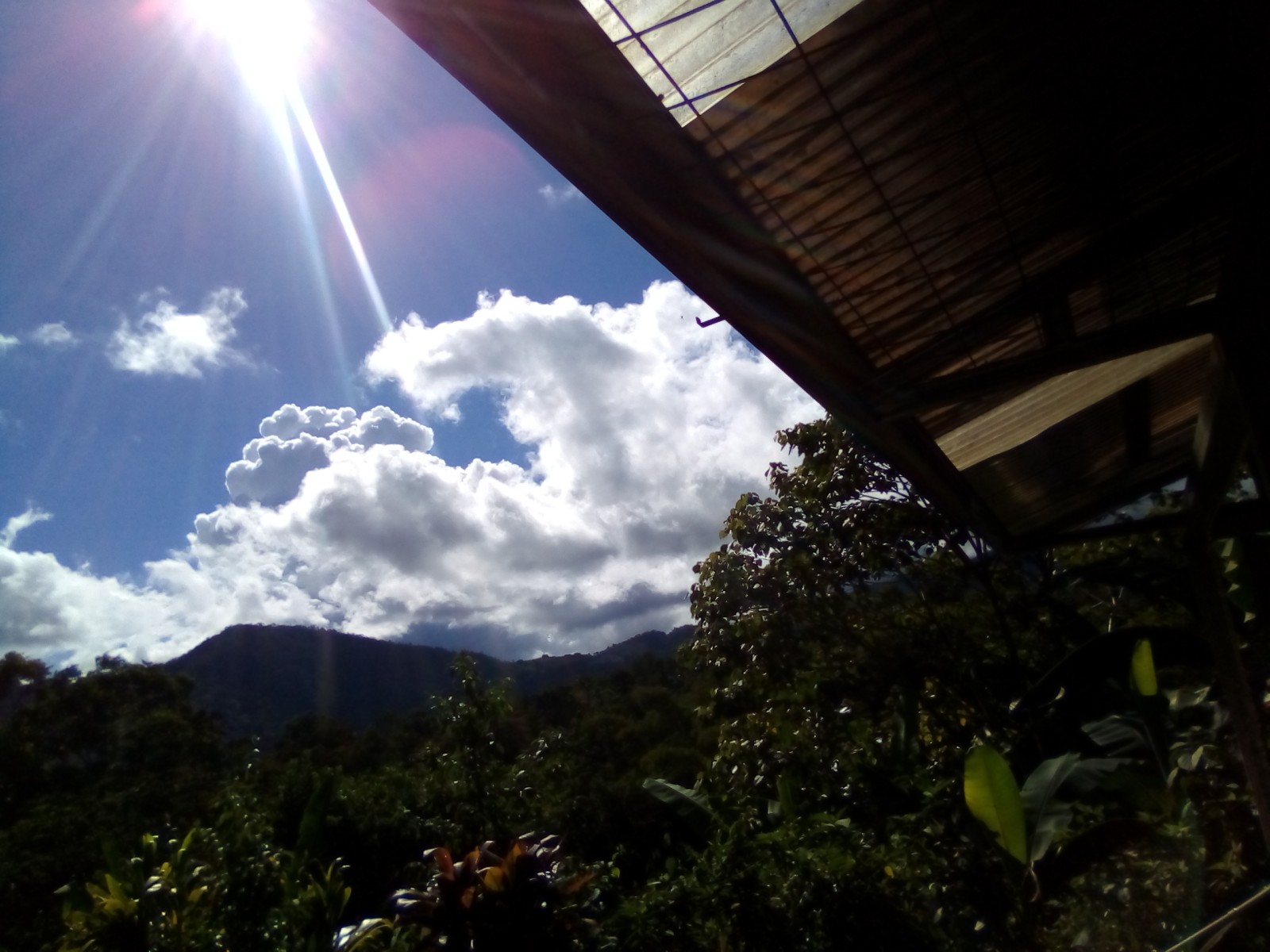
You, dear reader, are approximately 70% water. And I, dear writer, am somewhat the same. Montavia Estate is graced by abundant water and so it has become a friend. Here are some random thoughts about water.
A suggestion: A decade ago in our first year I was concerned about drainage. Rightly so. When it rained I would put on a poncho and rubber boots and sometimes little else because it was warm! I would start at the lower gate with a big hoe and work all the way back to the house clearing ditches. Doing that became a favorite form of meditation that was also a teaching about the logic of flow. I learned first hand how water picks up things in steep areas and drops them in flat areas. Writing this brings back many fond memories of joining with the land to celebrate rain. Where ever and who ever you are, I encourage you to experience such joy.
Water is a mystery. We can learn a great deal from scientists who have studied it. First among them, in my mind, is Doctor Gerald Pollack, who has spent a long and distinguished career at the University of Washington uncovering secrets of water that are so incredible few of his peers recognize the undeniable truth in his work. Dr. Pollack has shown that water in living cells organizes next to membranes as sheets of hexagons that laminate with opposing charge forming batteries. These arrays are one molocule thick and stack up by the hundreds. When exposed to light, they generate electricity and also act as purifiers. As of this writing Pollack is 87, looks 20 years younger, has several books in the works, and if anything, is engaged in evermore original thinking about fundamental physics. You will find his books at Amazon and his lectures and interviews on Youtube.
After a lifetime of diverse experience I’m hoping to be reincarnated as a hydrologist. The science of hydrology is concerned with the relationship between water and land. These scientists are rare and underappreciated, but they do work that has critical impact on our lives. There is more work to be done and interesting: what about water in the sky? How much do we have yet to learn about that? So I come to this story:
Dr. Will Happer is a professor emeritus of physics at Princeton University. He spoke recently to a large audience in Australia and received a standing ovation for questioning the mainstream climate narrative. That narrative is based on climate models that are in turn based on lab experiments. Happer’s team has repeated the lab work and sees things differently. But most important is what he has to say as a professional climate modeler about how that work is actually done.
Happer says that climate modeling is done in 4 stages in sequence factoring in data and assumptions according to many recipes. When the first 3 stages have been done, the 4th stage must be entered and that one has to do with the physics of water in the sky. He says that none of the builders of the 92 climate models currently in use understand water, so they just leave stage 4 out and celebrate completion.
Water occurs as a solid, a liquid, and a gas, all of which are in the sky. There is a state with special properties where water vapor, a gas, condenses into microscopic droplets that have unique electrical properties. Most scientists if they think about it at all, believe these micro droplets which we call clouds are the same as water vapor. But vapor is a gas. The micro droplets are so small that they hang in the air, but somehow they are combined into vastly bigger structures called rain drops. As Gerald Pollack points out, such combinations are unlikely because the micro droplets all have positive charge and repel each other. Somehow, they combine and turn into rain drops, each of which retains the positive charge, and then, according to Pollack’s calculations they fall at twice gravitational speed due to electrical attraction to earth itself, which has negative charge. There are many questions here, aren’t there?
People are concerned about carbon dioxide for many reasons. This important gas is soluble in water and is present in most rain drops as dilute carbonic acid. It could be that all rain is acid rain and that could be a good thing because it turns out according to a scientist studying soil in England that the biggest absorber of carbon dioxide on the planet, bigger than all of the oceans combined is soil fungus and how does all of that gas get into the ground well below the surface? The probable answer is acid rain. How do we begin to wrap our heads around this enough to study it? Certainly it will take another life time. It will be fun! Maybe you and I will work together.
9 thoughts on “Water”
Finally found a platform that works without any glitches. The registration process was quick and easy. Cheers to bdkirkiriya
https://shorturl.fm/rZDWp
https://shorturl.fm/2OVHW
Fairspinaffiliate is where it’s at! Been cruising this site for a bit and it’s great. Take a look, you won’t regret it: fairspinaffiliate
https://shorturl.fm/PTOjr
https://shorturl.fm/3edZH
Kz999a, never heard of it before! Decided why not, and I am happy with the games it has. Worth looking if you have time! Give it a try kz999a
Alright h2bt, I tried some games. Nice site! Good option if you’re looking for a reliable place to play. Give h2bt a spin.
Thinking of giving Vbetbrasil a shot. Anyone had any luck? Always looking for a new place to play! Here’s the link vbetbrasil.